

I have owned this BLACK+DECKER blower for a year and a half now, long enough for the honeymoon period to wear off and for the small annoyances to stack up alongside the things I still genuinely like about it. Most reviews you will read on this blower were written in the first two weeks of ownership, when everything is new and the battery hasn't started acting up yet. Mine was not. I run a hair salon four ten-hour days a week, which means my yard work happens in two narrow windows, the twenty minutes before I leave for a 7 a.m. opening and whatever daylight is left after dinner. That schedule does not leave room for a tool that needs babying, and after eighteen months I have a pretty clear list of what nobody mentioned to me before I bought it. I am telling you this not to complain, but because I have read enough breathless five-star write-ups to know the difference between a tool that is good and a tool that has simply not been used long enough yet to show its seams.
I have a half-acre lot with a mature black walnut tree that drops leaflets and green husks from late September through November, plus two white pines along the back fence line that shed needles almost continuously from October into January. That combination is harder on a blower than a straightforward oak or maple yard, because walnut husks are heavier and pine needles behave nothing like broad leaves. This is not going to be a rosy review. It is going to be the review I wish I had read before I spent eighty-some dollars on this exact model.
The Quick Verdict
A capable, lightweight blower for light-duty yards, but the battery gauge is unreliable, the single speed setting is a real limitation, and the plastic hardware around the nozzle clip is the first thing to fail.
Amazon Check Today's Price →Know what you're actually getting before it shows up on your porch
This blower has real strengths and real limits, and I would rather you go in with your eyes open than be surprised in month four the way I was. Check today's price on Amazon and read the full breakdown below before you decide.
Amazon Check Today's Price on Amazon →How I Actually Tested This, Beyond the Box
I did not write this review off one good weekend. I logged how I used the BLACK+DECKER blower across two full falls, one mild winter with a wet January, and the pine needle drop that never really stops in my yard. I used it on the back patio, the gravel side path, the front walk, and around the base of four raised beds where I overwinter garlic and shallots under straw. I paid attention to things a first-week review cannot catch: how the battery holds up after fifty-some charge cycles, whether the plastic housing loosens over time, and whether the noise level that seemed fine in October still felt fine when I was running it at 6:40 a.m. in March with the windows open next door.
I also compared it honestly against the corded electric blower I used for six years before this one, and against a neighbor's gas blower I have borrowed twice. I am not interested in telling you this is the best blower ever made. I am interested in telling you exactly where it holds up and exactly where it does not, because that is the review that would have saved me some frustration. I also asked two other gardeners in my neighborhood who bought the same model within a few months of me whether their experience matched mine, and both mentioned the same battery taper and the same single-speed frustration before I brought it up, which told me my experience was not just one unit having a bad run.
One more thing worth saying up front. I bought my own unit at full retail price from a hardware store, not a review sample, which means I have no reason to sand down the rough edges. If something annoyed me in month six, it is going in here.
The Battery Gauge Lies (Sort Of)
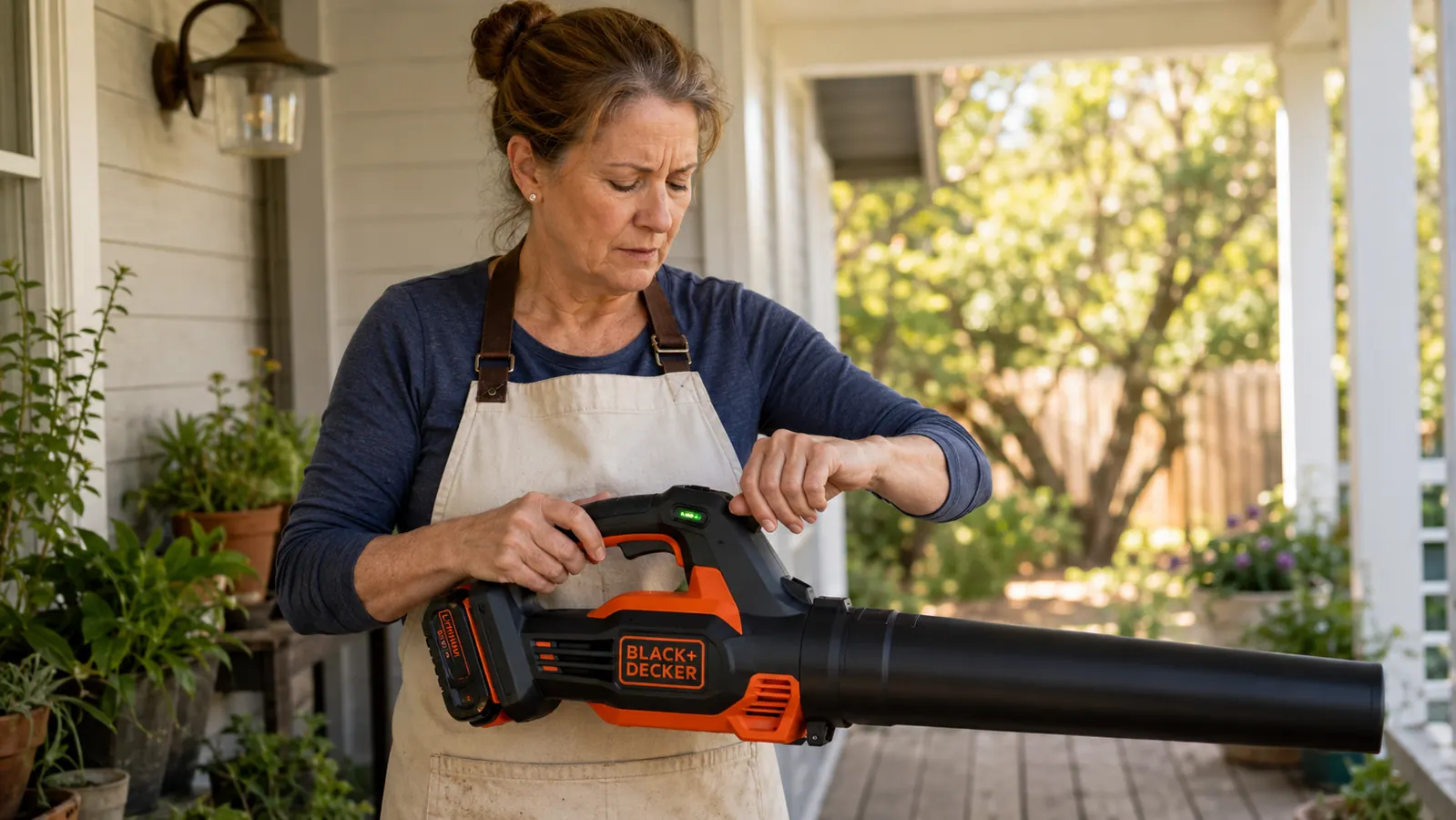
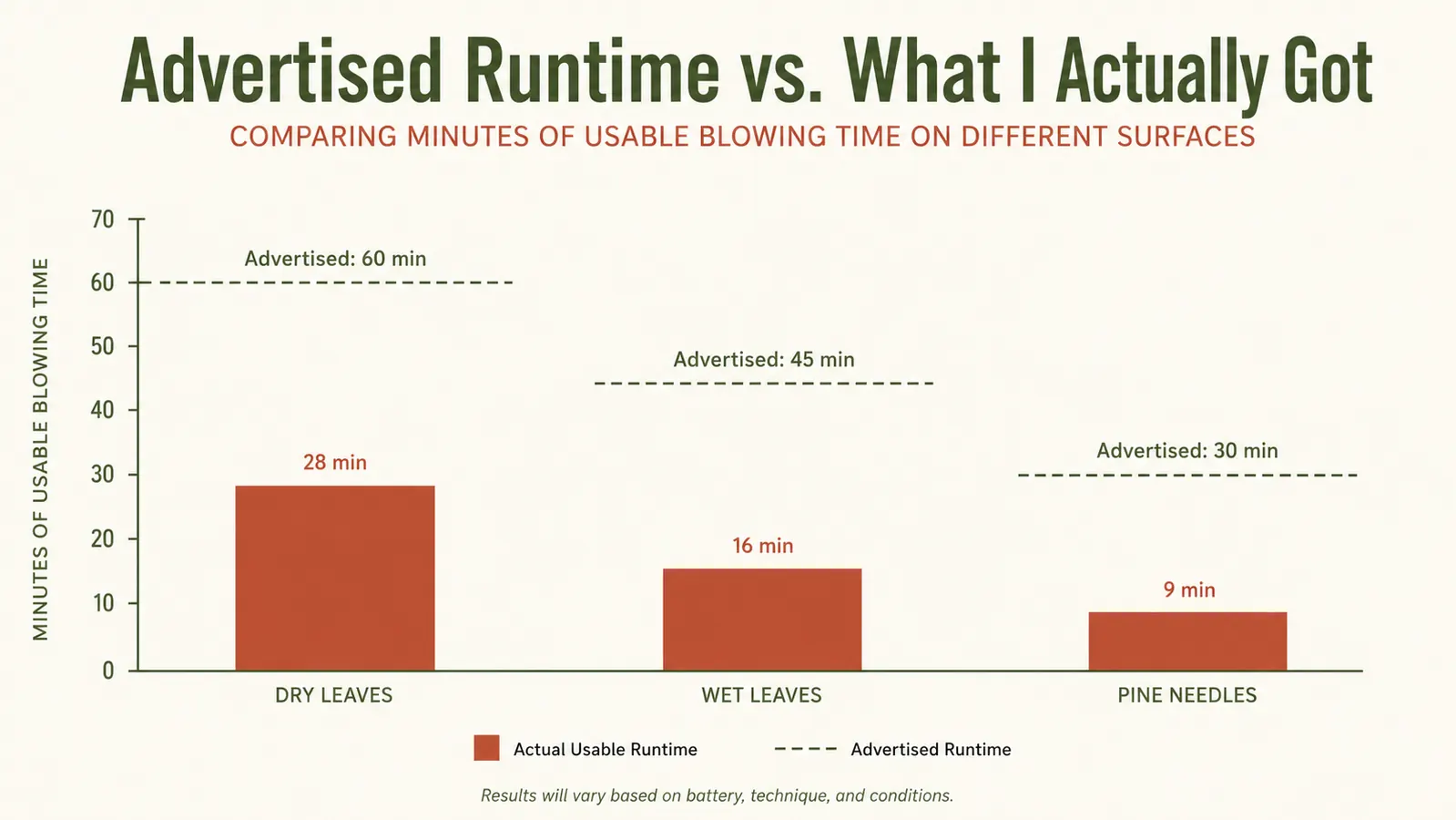
Nobody tells you this part. The battery indicator on the charger, and the general sense you get from the manual, suggests a fairly predictable runtime. What actually happens is that the BLACK+DECKER blower runs strong for the first ten to twelve minutes, then the power visibly drops off in the last third of the charge, well before the battery is technically dead. It does not fail gracefully. It tapers, and on a cold morning in November that taper starts even sooner. I have been mid-pass on the front walk, watched the airflow visibly weaken, and had to switch to finishing the last few feet by hand more than once.
The manual states a runtime figure, and technically the motor is still spinning right up until that number, but usable, effective blowing power is a shorter window than the number suggests. I would plan for fifteen solid minutes of real work per charge, not the fuller figure printed on the box. If your morning window is twenty minutes like mine, that gap matters.
Cold weather makes this worse. Below about forty degrees, which describes most of my pre-shift mornings from November through February, the battery loses noticeably more of its punch in the final stretch. I have started keeping the battery inside overnight rather than in the shed, which helps, but it is one more small chore nobody mentioned when I bought this.
The Single Speed Setting Nobody Warns You About
This model has one speed. On or off. That sounds like a minor detail until you are trying to gently coax pine needles out of a mulch bed without blasting the mulch itself six feet in every direction, or trying to clear leaflets off young garlic shoots in October without flattening them. A blower with a low setting would let me feather the airflow. This one does not, and I have learned to hold it at an angle and further back from delicate beds rather than relying on the tool to modulate itself.
It also means the blower is either fully loud or off, with nothing in between for early mornings when I want to clear just the porch steps without waking the whole street. I have gotten used to it, but I would have liked to know going in that variable speed was not an option on this particular model.
Noise Complaints I Didn't Expect
Every listing for this blower emphasizes that it is quieter than a gas blower, and compared to my neighbor's gas model, that is true. What the listings do not mention is that the pitch of the motor is a higher, more piercing whine than a gas engine's lower rumble, and higher pitched sounds carry differently through a quiet neighborhood at dawn. My next door neighbor, who works nights and sleeps until nine, mentioned it to me directly after about two months, not in an unfriendly way, but clearly enough that I moved my pre-shift blowing sessions to the side and back of the house instead of the front walk closest to her bedroom window.
It is genuinely quieter in raw volume than gas. It is not quieter in a way that disappears into the background the way a lower engine rumble sometimes does. If you have close neighbors and an early routine like mine, factor that in before you assume quieter automatically means unnoticeable.
The Nozzle Clip That Cracked in January
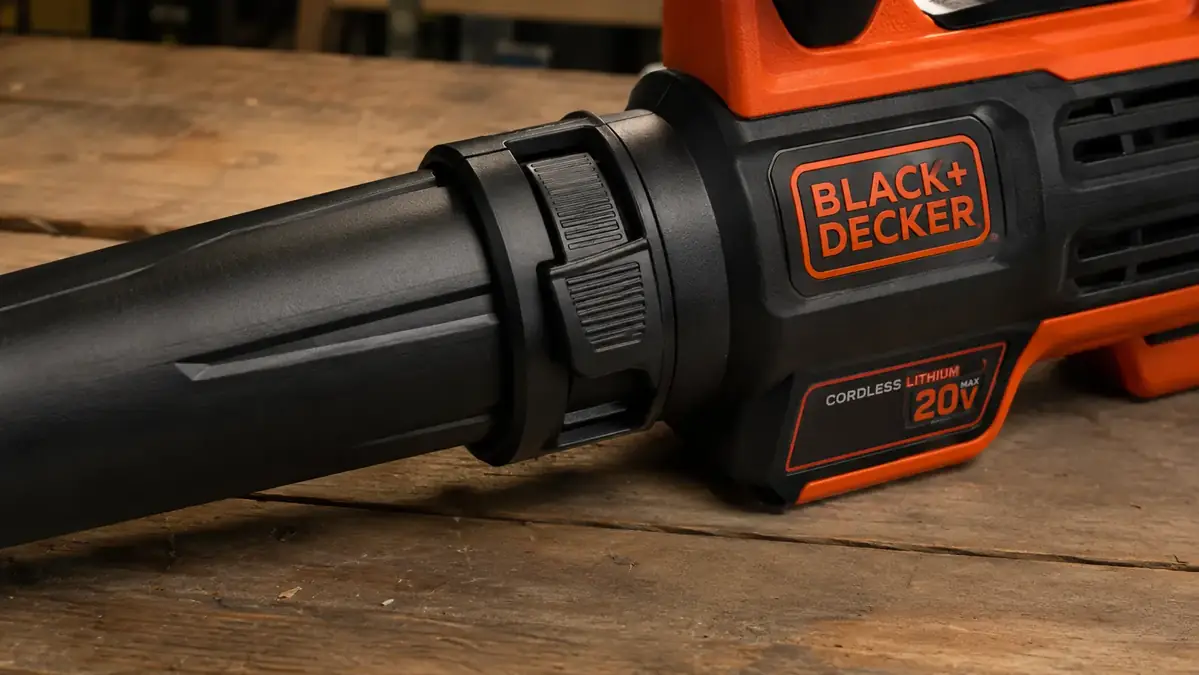
At around fourteen months of regular use, the plastic clip that holds the nozzle attachment onto the main housing developed a hairline crack. It still holds, technically, but the nozzle now has a small wobble it did not have when it was new, and I am careful not to bump it against the porch railing the way I used to without thinking. This is the first piece of hardware on the tool that has shown real wear, and it is exactly the kind of small plastic part that is easy to overlook when you are reading a glowing five-star review written in the first month.
I want to be fair here. Fourteen months of regular seasonal use, including some drops onto concrete that were entirely my own fault, is not a short life for a moving joint made of plastic. But it is the kind of detail I would want to know before buying, especially if you tend to be rougher on tools than I try to be.
What the Advertised Air Speed Number Doesn't Tell You
The air speed figure on the box is measured at the nozzle tip in controlled conditions, not three feet out where the leaves actually are. By the time that airflow reaches ground level and spreads across a two-foot swath, the effective force is noticeably less than the number on the packaging implies. On dry, light debris this barely matters. On heavier walnut husks and wet, matted pine needles, it matters quite a bit, and I have had to make two or three passes over the same stretch of gravel path more times than the marketing copy would lead you to expect.
None of this makes the blower bad. It makes the number on the box a best-case figure rather than a real-world guarantee, which is true of almost every blower at this price point, not just this one. I just wish someone had said so plainly instead of letting me assume the box number was what I would feel in my hands.
Comparing It to the Corded Blower I Retired
For six years before this one, I used a corded electric blower that plugged into an outlet on the back porch. It never once ran out of power mid-job, and it never developed a nozzle wobble, because there was no battery to taper and fewer moving joints to crack. What it did have was a cord that snagged on the raised bed corners and the wheelbarrow every single time, and a hard limit on how far from the house I could work before I needed an extension cord dragged out behind me. Switching to cordless solved that specific problem completely. I can walk the whole perimeter of the yard, out past the pines, without once thinking about a cord.
What I did not expect was to trade one set of limitations for another. The corded blower had unlimited runtime and no gauge to second-guess. This one has freedom of movement and a battery that requires planning around. Neither tool is strictly better. If your yard is small enough that a cord could reasonably reach every corner, I would not assume cordless is automatically the upgrade. It is a different set of tradeoffs, not a straightforward improvement, and nobody selling this blower is going to tell you that part either.
What I Liked
- Genuinely lightweight for an hour of continuous use before a shift
- Starts reliably even after sitting unused for a few weeks in the off season
- Quieter in raw decibels than a comparable gas blower
- Good on dry, light leaf litter with minimal effort
- Battery and charger included, no separate purchase needed to start using it
Where It Falls Short
- Single speed setting with no low or medium option for delicate beds
- Battery power tapers noticeably in the final third of a charge, especially in cold weather
- Plastic nozzle clip showed a hairline crack after about fourteen months of regular use
- Higher pitched motor whine carries further in a quiet neighborhood than the decibel rating suggests
- Struggles with wet, matted debris and heavy walnut husks compared to dry leaves
The box number is a best-case figure, not a promise. Once I stopped expecting the blower to match the packaging and started planning around what it actually does, I liked it a lot more.
Who This Is For
This BLACK+DECKER blower makes sense for someone with a smaller lot, mostly dry leaf debris, and a schedule like mine where a lightweight, grab-and-go tool matters more than raw power. If you have a walk, a porch, a driveway, and a couple of beds to keep clear in the fifteen minutes before you leave for a shift, it earns its place in the shed. It is also a reasonable fit if variable speed and long continuous runtime are not priorities for you, and you are comfortable doing a second pass on the tougher spots rather than expecting one clean sweep every time. It is also a solid pick if this is your first cordless blower and you are coming from raking by hand, since even with all its quirks it is still a meaningful upgrade over a rake and a tarp on a rushed morning.
Who Should Skip It
If you have a lot with mature walnut, sweetgum, or other heavy-debris trees across more than half an acre, or if you need to feather the airflow around delicate seedlings and mulch beds regularly, the lack of a variable speed setting will frustrate you the way it occasionally still frustrates me. Anyone hoping the box's air speed number will hold up unchanged at ground level on wet or matted debris should also look elsewhere, or at least go in with adjusted expectations. This is a good tool for the right yard. It is not the tool for every yard, and I would rather tell you that now than have you find out in month fourteen the way I did. I would also steer you elsewhere if you already own a reliable corded blower and your whole property sits within reach of one good extension cord, since in that case you would mostly be trading a known set of limitations for a different, less predictable one.
Go in knowing exactly what you're buying
This blower has earned its spot in my shed, but it took a full season of real use to know its limits. If a lightweight, grab-and-go tool for light to moderate debris fits your yard and your schedule, check today's price on Amazon.
Amazon Check Today's Price on Amazon →