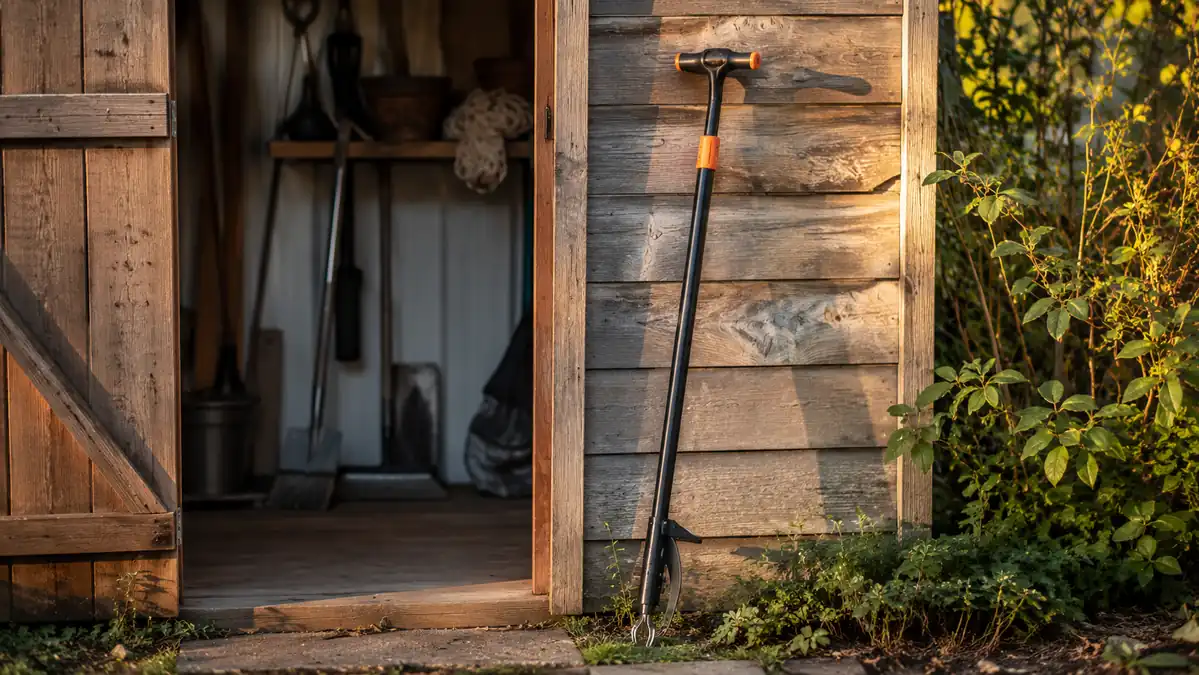
I want to write the version of this Fiskars Stand-Up Weed Puller review that nobody else seems to write, the one that doesn't end with everything being wonderful. I've had this weeder for five months now, since my neighbor Carl leaned his over the fence one Saturday and said his knees didn't hurt anymore. I bought one that same week, mostly for the raised vegetable beds where the sandy soil never held onto a hand trowel very well, and I've used it steadily since, through a wet spring, a scorching July, and a stretch of dry August where the ground turned nearly as hard as the clay Carl warned me about in his own yard.
Most of what I'd read online before buying was either a five-star rave or a one-star complaint about a bent claw, nothing in between. So this is the in-between review. The stuff I actually noticed, good and not so good, after using this tool more times than I can count in the small windows I get outside, usually a stretch before a 6am shift or an hour after the dishes are done.
The Quick Verdict
A genuinely useful tool for pulling taprooted weeds without kneeling, but it comes with real quirks around storage, weight, and slope handling that the product photos never show you.
Amazon Check Today's Price →Before you buy one, here's what the five-star reviews leave out.
It still earns its place in my shed, but not for the reasons the marketing photos suggest. See today's price on Amazon and decide for yourself.
Amazon Check Today's Price on Amazon →How I Actually Tested It
I didn't test this the way a lot of reviews suggest, one tidy afternoon in a soft flower bed with good lighting. I used the Fiskars the way I actually garden, which is inconsistent, rushed, and often at the wrong time of day. Some sessions were fifteen minutes before work with dew still on everything. Others were forty minutes on a Sunday when I finally had a real stretch of time and decided to tackle the whole vegetable bed border at once, including a patch that runs along a slight slope down toward the drainage ditch at the back of the yard.
That slope turned out to matter more than I expected, and I'll get to it. I also left the tool outside more than I should have, twice overnight in the rain because I forgot it was still leaning against the tomato cage, which is relevant to one of the honest complaints below. I'm not trying to baby this thing for the sake of a review. I used it the way most people actually use garden tools, a little carelessly, and that's where some of its rougher edges showed up.
I also used it on the narrow strip of gravel path between the vegetable beds where weeds keep pushing up through the stones, mostly out of curiosity rather than expectation. It struggled there in a way I hadn't anticipated. The claws need loose or reasonably soft ground to seat properly, and gravel just shifts under the platform instead of letting the claws bite in. It's a small use case, but if you were hoping this tool would double as a solution for path weeds between pavers, I'd manage that expectation now rather than finding out the hard way.
The Unboxing and Assembly Nobody Mentions
Before I even got to weeding, there was the box. It arrives in a long, narrow package that barely fit in my car's trunk diagonally, and the handle needs to be attached to the claw mechanism before you can use it. The printed instructions were a single small diagram with no written steps, and it took me two tries to get the assembly bolt seated correctly, the first attempt left a slight wobble in the joint that I didn't notice until I was already out in the yard and felt the handle flex more than it should have under pressure.
Once it was tightened properly the second time, the wobble disappeared completely and never came back, so this isn't a lasting defect, just a five-minute assembly step that the product listing doesn't really prepare you for. If you order this, budget a few extra minutes before your first weeding session, and double check that the connecting bolt is fully tightened before you put any real weight on the platform.
The Rust Spot Nobody Warns You About
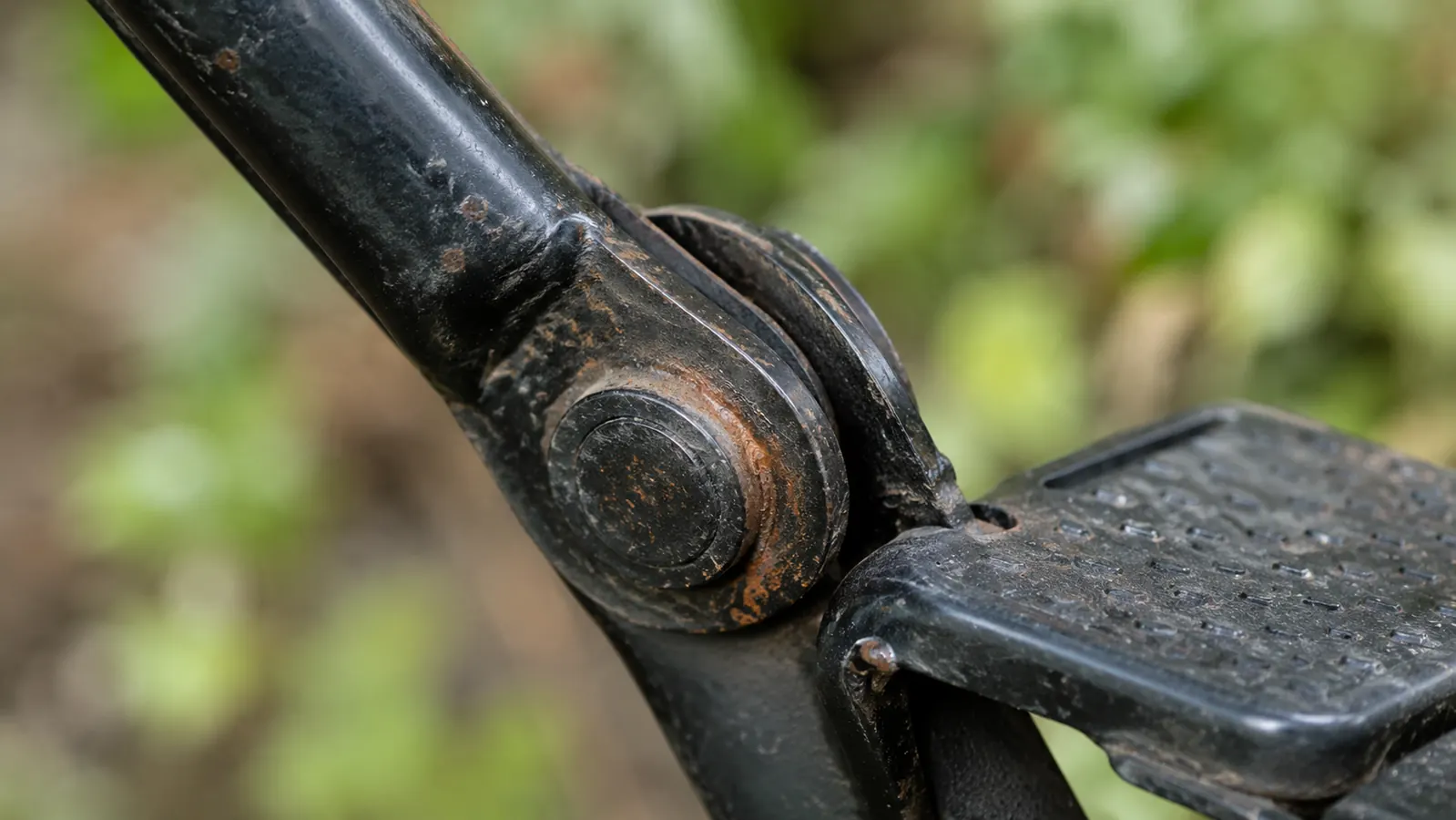
Because it lives outside against the shed more often than it should, I've now got a small patch of surface rust forming right at the pivot joint near the foot platform, the spot where the mechanism hinges when you pull back on the handle. It's not affecting how the tool works, the claws still close and eject exactly the way they did on day one, but it's the kind of detail that would have changed my expectations going in. Stainless steel claws are advertised prominently, and they've genuinely held up, no rust on the business end at all. The joint hardware around them is a different story, and if you're someone who, like me, sometimes forgets a tool outside overnight, you should plan on wiping it down and storing it somewhere dry rather than assuming the whole tool is weatherproof because the claws are stainless.
To be fair, a little rust on a hinge after months of inconsistent outdoor storage isn't a defect, it's a consequence of how I treated it. But nobody mentions this in the glowing reviews, and I think it's worth knowing before you buy, especially if your shed situation looks anything like mine.
Where the Motion Falls Apart on a Slope
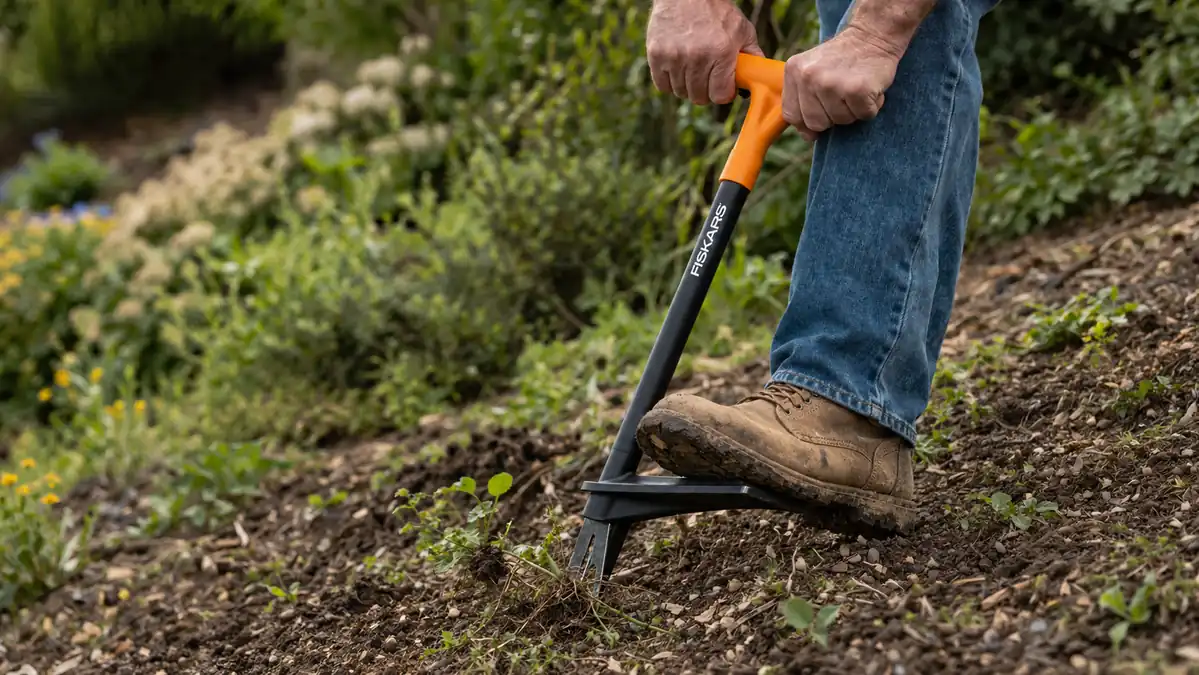
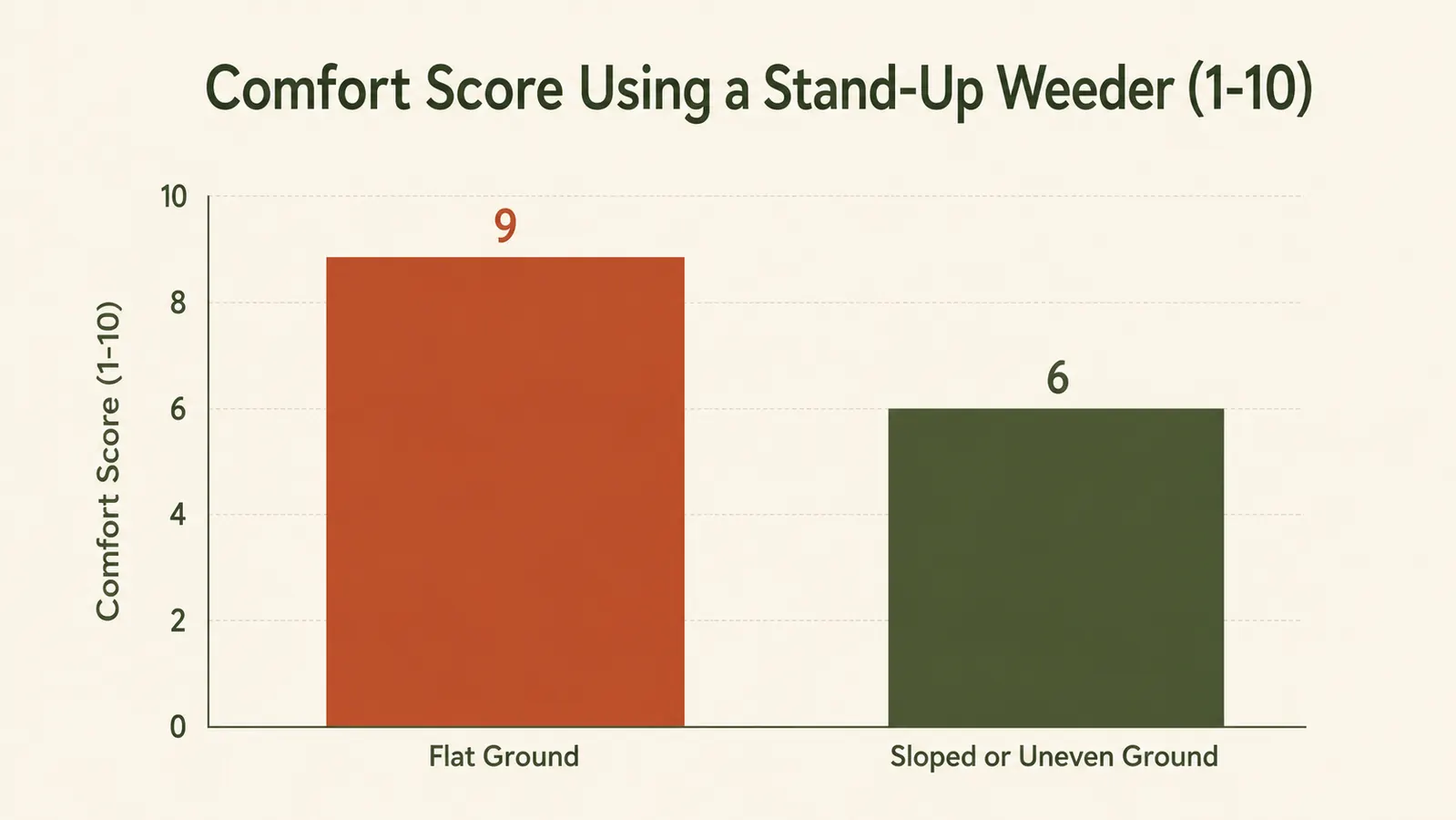
This is the complaint I feel most strongly about, because it's the one that actually affects how well the tool does its main job. On flat ground, the whole design makes sense, you step down evenly with both feet essentially under you, the platform takes your weight straight down, and the claws drive in clean. The stretch of bed along my drainage slope isn't dramatic, maybe a ten or fifteen degree grade, but it's enough that stepping onto the platform with your full weight becomes a balancing act instead of a simple stomp.
I found myself planting my back foot wider than usual and pressing down at an angle rather than straight down, which meant the claws sometimes went in crooked and grabbed only part of the root instead of centering on it. On level ground I almost never have to try twice. On that slope, I'd say close to a third of my attempts needed a second try, either because the claws didn't seat evenly or because I lost my footing slightly and had to reset. It's not dangerous, but it's not the smooth, single-motion experience the tool delivers everywhere else in my yard, and if your garden has any real grade to it, you should expect the same adjustment period, if not permanent workaround.
The Sound and the Vibration in Harder Ground
Nobody mentions the noise either. In the sandy vegetable bed, this tool is nearly silent, a soft push into loose soil and a quiet click when the claws close. Along the fence line where the ground is more compacted, stepping down hard enough to drive the claws in produces a real clank, metal against packed dirt and small buried stones, and a vibration that travels up through the handle into your hands. It's not painful, but after fifteen or twenty weeds in that section, my palms have a faint buzzing feeling similar to using a shovel on rocky ground for too long. If you've got any issue with your hands or wrists, that vibration is worth testing for yourself before committing to a big session in tough soil.
Is It Worth the Price, Honestly
At today's price, this isn't an impulse buy the way a five dollar hand trowel is, and I think that's worth saying plainly. I already owned a trowel, a hoe, and a hand fork before this arrived, so I wasn't buying my first weeding tool, I was paying to upgrade a job I could technically already do. Five months in, I don't regret the purchase, but I also don't think it's a tool everyone needs, especially if your garden is small enough that kneeling for ten minutes isn't a real burden on your body.
Where the price makes sense to me is in hours saved and knees spared over a full season, not in any single afternoon. Carl did the math out loud once, dividing what he paid by the number of weekends he's used his, and landed on a number low enough that neither of us worried about it again. If you're weighing this against a cheap trowel you already own, the honest answer is that it's a different tool solving a different problem, standing versus kneeling, not a straight upgrade, and it's worth buying for the standing part specifically, not for anything the trowel couldn't already do sitting down.
What It's Still Genuinely Good At, Even After All That
I want to be fair here, because after listing out every complaint I've collected over five months, it would be easy to make this sound like a tool I regret buying, and that's not true. On flat, ordinary ground, which is the vast majority of my yard, the Fiskars still does exactly what it promises. Dandelions and thistle come up whole, I'm not kneeling, and a job that used to leave my knees sore now leaves nothing sore at all. The claws haven't dulled, the eject mechanism has never once jammed on me even with the rust at the joint, and the core function of the tool is as solid today as it was the first week.
The honest version of this review isn't that the tool fails, it's that the marketing photos show you the best-case scenario, flat ground, soft soil, a tidy little pile of weeds, and a fresh tool that's never sat outside in the rain. Real gardens have slopes, real sheds don't always have room, and real tools left outside pick up rust at the joints. None of that changes whether it's worth buying, but all of it changes what you should expect, and Carl, for what it's worth, has the same rust spot on his after telling me his own weeder lives on his back porch year round.
What I Liked
- Still pulls taproot weeds clean on flat ground with almost no repeat attempts
- Stainless steel claws show no rust or dulling after five months
- Eject mechanism has never jammed, even with wear on the pivot joint
- Genuinely eliminates kneeling for most weeding sessions
Where It Falls Short
- Too long for a standard narrow tool rack, awkward to store indoors
- Front-loaded weight makes one-handed carrying tiring over a long session
- Pivot joint develops surface rust if left outside or in rain, unlike the claws
- Loses accuracy and requires a wider stance on sloped or uneven ground
- Produces noticeable clanking and hand vibration in compacted or rocky soil
- Needs a few minutes of careful handle assembly before first use
The photos show you flat ground and a tidy pile of weeds. Nobody photographs the rust spot or the slope where your footing gets awkward.
The Grip Nobody Mentions on Damp Mornings
One last small thing, since I've been early-morning weeding with dew still heavy on everything more often than not. The handle is a plain metal tube with no rubber or foam grip section, and on those wet mornings, wearing my usual thin garden gloves, my hands would slide slightly during the pull-back motion until I tightened my grip more than felt natural. It's never caused me to drop the tool or lose control of it, but by the end of a longer session my forearms noticed the extra effort of gripping harder than I would on a rubber-handled hoe.
A pair of gloves with more texture on the palm solved most of it, and dry mornings never present the issue at all, but it's the kind of small detail that only shows up after enough repeated use, and it's not something you'd catch from a single demo in a store.
Who This Is For
If most of your weeding happens on reasonably flat, established beds or lawn edges, and you have somewhere dry to store the 39 inch Fiskars, even if that means leaning it in a corner of the garage rather than hanging it, this is still one of the better ways I've found to clear taproot weeds without kneeling. It rewards short, regular sessions in the small windows a lot of us actually get to garden in, rather than one big weekend project.
Who Should Skip It
If your yard has real slope to it, if your storage space is tight and already crowded with long-handled tools, or if you tend to leave equipment outside between uses the way I sometimes do, go in with the right expectations, or consider whether a shorter-handled tool might suit your space better. It still does its main job well, but the extra quirks around slope, storage, and weather exposure are real, and they're the parts nobody puts in the product photos.
Now you know the parts nobody mentions. Here's what it's still worth.
Rust spot and all, it's still the reason my knees don't hurt after weeding. See today's price on Amazon and judge it with the full picture.
Amazon Check Today's Price on Amazon →