
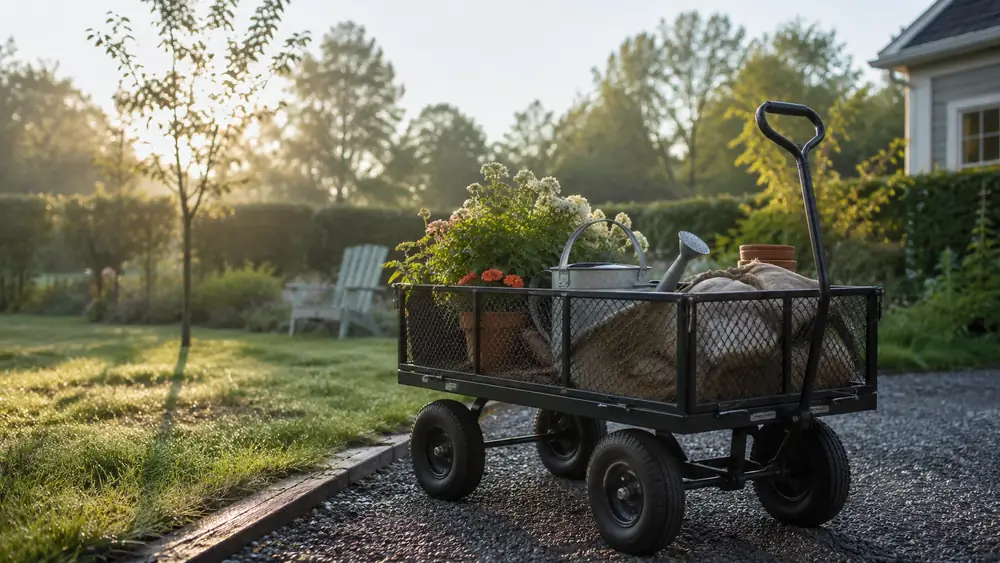
I bought this cart in April because I was tired of making four trips across the yard with a five-gallon bucket every time a load of mulch got delivered. I work twelve-hour shifts, and the only real gardening time I get most days is the hour after I wake up before the sun is fully up, or the hour after dinner before it gets dark. Four bucket trips eats half of that. One cart trip does not. Some mornings that hour is all I get before I have to shower and be out the door for a shift at the hospital, so every minute saved on hauling is a minute I get to spend actually working the beds instead of walking back and forth across the yard.
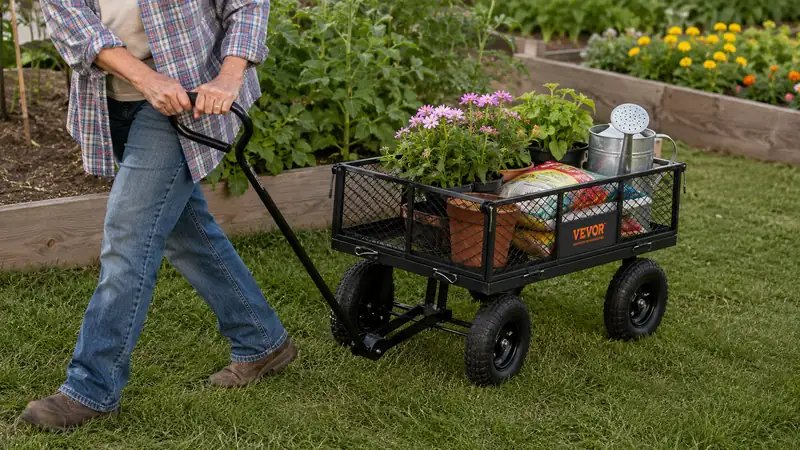
The VEVOR Steel Garden Wagon Cart is rated for 500 pounds, rolls on 10-inch all-terrain tires, has mesh sides you can detach to turn it into a flatbed, and a handle that rotates 180 degrees so you can push or pull depending on what makes sense for the load. I have had it since the second week of April, and it has hauled everything from forty bags of cedar mulch to a cord of oak firewood to three trips of wet, heavy topsoil after a rainy stretch in June.
The Quick Verdict
A genuinely sturdy hauling cart that earns its keep on mulch, soil, and firewood days, though the assembly takes real patience and the mesh sides show their first scuffs fast.
Amazon Check Today's Price →Stop making four trips when one will do
If your yard work keeps getting cut short because hauling takes longer than the actual job, this is the cart that fixes that math. Check today's price on Amazon before your next mulch delivery.
Amazon Check Today's Price on Amazon →How I've Used It
I have a quarter-acre lot with four raised beds along the back fence, a gravel path that runs from the driveway to the shed, and a wood pile on the side yard that my husband Gordon restocks every fall. Before the VEVOR cart, hauling anything heavier than a bag of potting soil meant either the wheelbarrow, which tips if you load it wrong, or repeat trips by hand. Neither one worked well with the amount of time I actually have most mornings.
Since April I have used the cart for mulch deliveries twice, one big topsoil haul in June, weekly yard waste runs during the summer when the beds needed thinning, and now, starting in September, hauling split firewood from the pile to the back porch rack. That is close to six months of regular, sometimes daily, use on grass, gravel, and the cracked concrete slab behind my shed.
I did not baby it. It has sat out in two thunderstorms because I forgot to roll it back into the shed, and it has been loaded past what I would call a reasonable weight more than once, because when the mulch truck shows up at 6:15 in the morning, I am not doing math, I am just loading the cart and going.
Assembly and First Impressions
The box arrived heavier than I expected, and assembly took me about fifty minutes on a Sunday afternoon, working alone with the included wrench and a cordless drill I used for the bolts that made sense to power through. The instructions are workable but not great. I had to lay all the hardware out on the garage floor and match pieces by size before I started, which added ten minutes I did not plan for.
Once it was together, the frame felt solid. There is no wobble in the axle, the wheels spin freely, and the welds on the steel frame look clean, not the kind of rough factory weld I have seen on cheaper carts at the big box store. The mesh sides clip into the frame with a simple pin system that took me a minute to figure out the first time and about three seconds every time since.
My one real complaint about setup is that the instructions show the rotating handle assembly out of order compared to how the bolts actually line up. I had to back out one bolt and reseat it after I realized the handle was catching on the frame when I tried to rotate it. Once corrected, it rotates smoothly through the full 180 degrees without any grinding or sticking.
Hauling Mulch, Soil, and Firewood
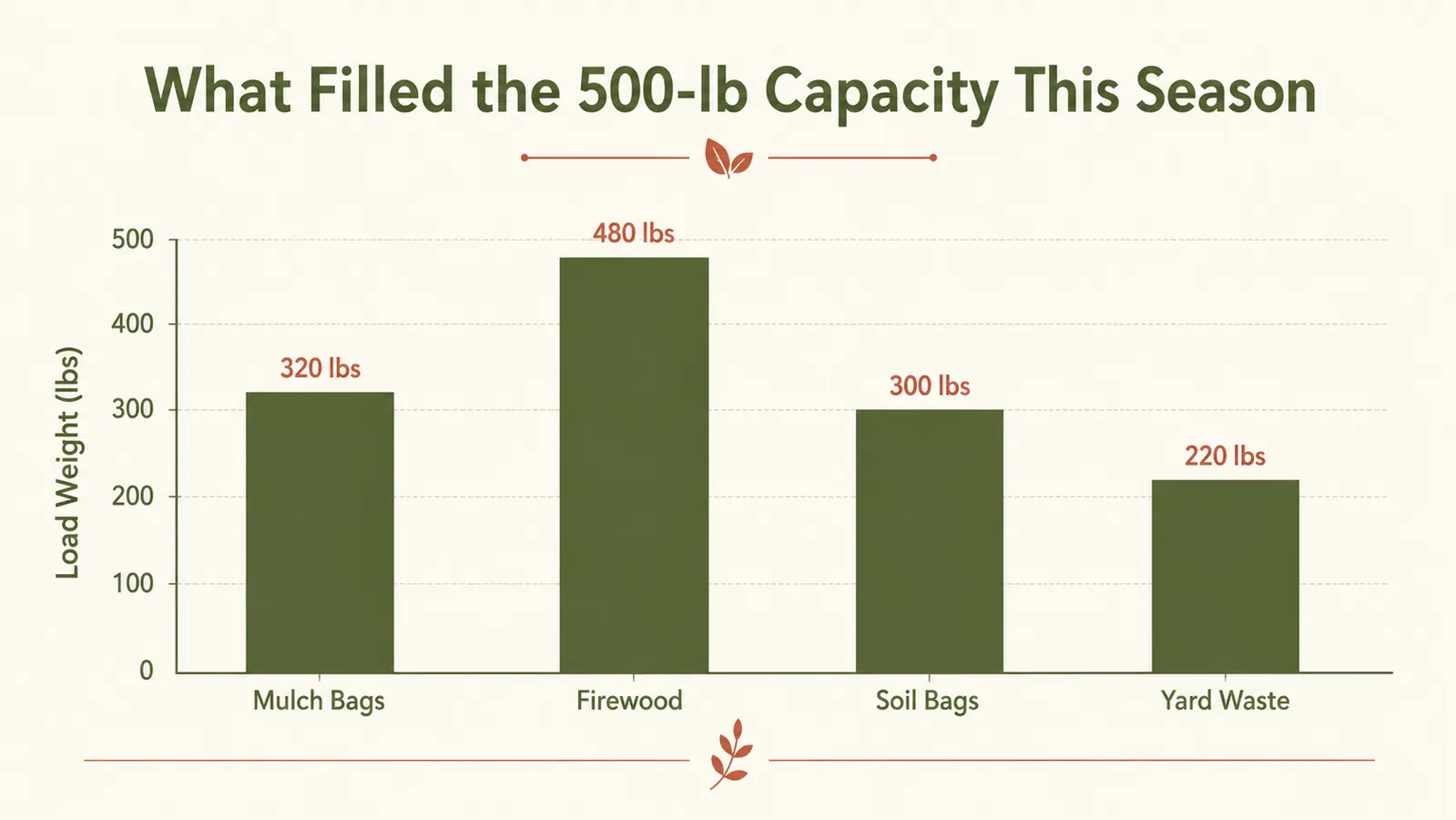
The first real test came in late April when six cubic yards of cedar mulch got dumped at the end of my driveway. In past years I have shoveled that pile into a wheelbarrow in loads that felt like they took forever, tipping twice along the way because the wheelbarrow's single wheel does not forgive an uneven push. With the VEVOR, I loaded roughly eight to ten bags' worth of mulch by shovel each trip, wheeled it down the gravel path to the beds, and dumped it by tilting the frame forward. Six trips instead of fifteen, and no tipping.
In June I had three yards of topsoil delivered after a rainy stretch left my beds needing a top-up. Wet soil is heavier than dry mulch by a wide margin, and this is where I actually pushed the cart close to its stated 500-pound limit. It handled it, but I noticed the tires compress more under a heavy wet load, and pulling it across grass took noticeably more effort than pulling it on the gravel path. That is not a flaw in the cart so much as physics, but it is worth knowing before you load it to the brim.
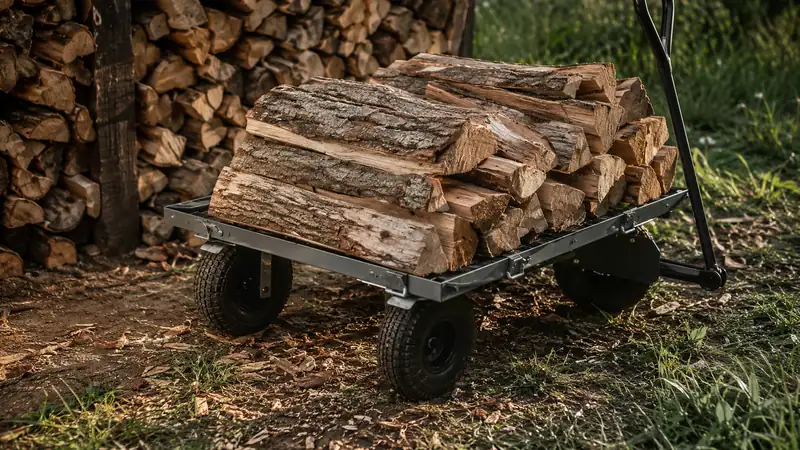
Firewood has become the fall routine. Gordon splits logs at the pile, I load the cart with the mesh sides removed so it runs as a flatbed, and I make two or three trips to the porch rack most Saturday mornings. The flatbed conversion takes under a minute, no tools needed, just unclipping the mesh panels and folding them down. It is the single feature I did not expect to use as much as I do.
The Wheels and Rough Ground
The 10-inch all-terrain tires are the reason I chose the VEVOR over a couple of cheaper options that used small plastic wheels. My gravel path is not smooth, and the transition from gravel to grass to the cracked concrete behind the shed would have chewed up a smaller wheel fast. Six months in, the tread still looks close to new, and I have not had a single flat or a wheel that needed air.
Where the wheels do struggle is soft, saturated ground. After three straight days of rain in late June, I tried to cross a low spot in the yard that had turned to mud, and the cart sank enough that I had to back it out and go around. That is a fair trade for how well it handles everything else, but if your yard has a low, wet corner, plan your route around it rather than through it.
The rotating handle earns its keep on the gravel path especially. Pulling behind me on the way out to the mulch pile, then rotating the handle to push it back toward the beds once loaded, keeps the weight in front of me instead of dragging behind, which matters more than I expected on a body that has been on its feet all night at the hospital before I ever touch the cart.
Alternatives I Considered Before Buying
Before I settled on this cart, I looked at a plastic-bed garden wagon that runs cheaper and a two-wheel dump cart that hitches behind a riding mower, since Gordon has one sitting in the shed from before we downsized our lot. The plastic wagon was tempting on price, but the reviews were full of complaints about the bed cracking under heavy loads within a season or two, and my mulch and soil hauls are exactly the kind of heavy, repeated load that would stress a plastic bed. I did not want to be back here in eight months writing a different review about a cracked wagon.
The mower-hitched dump cart would have worked for the firewood and mulch runs, but it only makes sense if you are already riding the mower to where you need the load, and most of my hauling starts at the driveway or the side yard, not out in the middle of the lawn. It also would have meant firing up the mower for a five-minute haul, which felt like more hassle than it solved. A cart I can grab by hand at 6 a.m. without starting an engine won out.
I also priced out a smaller two-wheel utility cart with a 300-pound capacity, which would have been lighter to maneuver but would have meant more trips for the bigger mulch and soil deliveries, which defeats the entire reason I bought a cart in the first place. Given how much of my gardening happens in a narrow morning window, fewer trips mattered more to me than a slightly lighter pull.
The Mesh Sides and What I'd Change
The mesh sides are sturdy enough to hold in loose mulch and yard waste without gaps, and they detach in seconds for the flatbed conversion I mentioned. My complaint is cosmetic rather than functional. After the mulch and firewood season, the mesh shows scuff marks and a couple of small dents from where logs shifted during a bumpy pull across the gravel. It still functions exactly as it should, but if you care about how it looks after a season, know that it will not stay showroom clean.
I also wish the tilt-dump mechanism locked more securely in the upright position. Twice now, on a downhill section of my driveway, the bed has started to tip forward on its own before I meant it to, spilling a few bags' worth of mulch onto the gravel. It is not a dangerous issue, just an annoying one, and I have adjusted by keeping a hand near the frame when I am on any kind of slope.
What I Liked
- Steel frame and welds feel genuinely sturdy after six months of daily-in-season use
- 10-inch all-terrain tires handle gravel, grass, and cracked concrete without issue
- Flatbed conversion for firewood takes under a minute with no tools
- Rotating handle lets you switch between pushing and pulling depending on the load and the slope
- Held a heavy wet topsoil load close to the 500-pound rating without frame flex
Where It Falls Short
- Assembly instructions have the handle assembly steps slightly out of order
- Mesh sides pick up cosmetic scuffs and small dents after a season of mulch and firewood runs
- Tilt-dump mechanism can start to tip on its own on a downhill slope
- Struggles in soft, saturated ground after heavy rain
Six trips instead of fifteen, and no tipping. That is the whole review in one sentence.
Who This Is For
This cart makes the most sense for someone with a real yard, mulch beds, a wood pile, or regular soil and material deliveries, who does not have unlimited time to move it all by hand or by wheelbarrow. If your gardening happens in short windows, before a shift or after dinner, cutting your hauling trips in half or better is not a small thing. It is the difference between finishing the job and running out of daylight before you do. I also think it is worth it for anyone helping an older parent or neighbor keep up a yard, since the rotating handle and the flatbed conversion mean one person can load and move a heavy delivery without needing a second set of hands.
Who Should Skip It
If your yard is small enough that a few bucket trips or a basic wheelbarrow already gets the job done in a few minutes, this is more cart than you need, and the storage space it takes up in a shed or garage is worth considering before you buy. It is also not the right tool if your whole yard is soft, low-lying ground that stays wet most of the season. Those tires do best on gravel, packed dirt, and grass, not standing mud. And if you are only ever moving small potted plants or hand tools around a patio, a simple tote or a small two-wheel cart will serve you better than something built to move hundreds of pounds of mulch.
Six months in, it still earns its spot in my shed
If mulch, firewood, or soil deliveries are eating your limited yard time, this cart is the fix I wish I had bought two seasons earlier. Check today's price on Amazon and see if it fits your setup.
Amazon Check Today's Price on Amazon →