
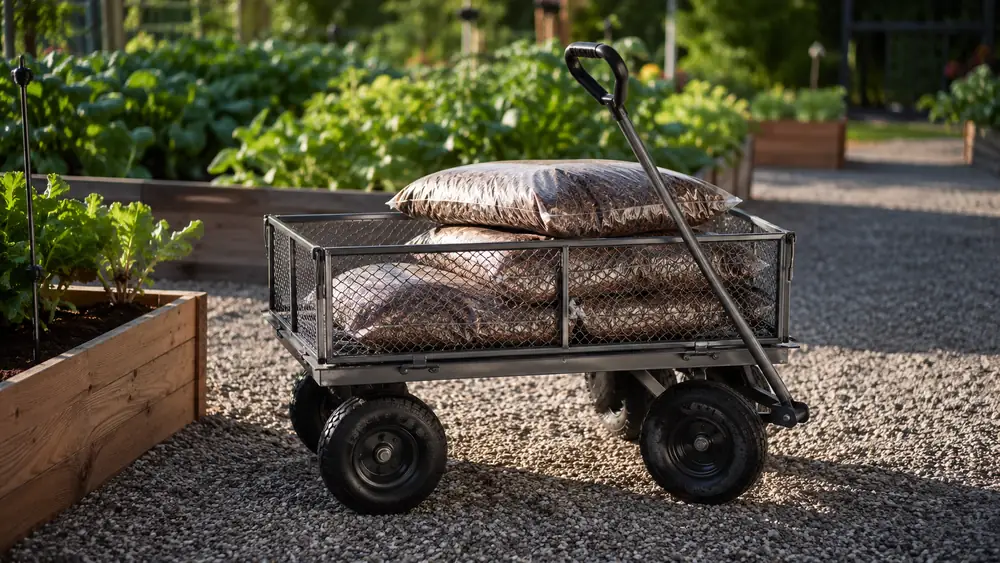
Short answer: if you're hauling anything heavier than a few scoops of compost across a yard with any bumps, dips, or gravel in it, the VEVOR Steel Garden Cart earns its keep fast. I've had mine parked against the shed since early spring, and it has replaced the single-wheel plastic wheelbarrow I used for years for almost every hauling job on my quarter acre.
That wheelbarrow, a True Temper 6 cubic foot poly-tub model, isn't a bad tool. I still reach for it on certain jobs, and I'll get into exactly which ones later. But this comparison comes from a full season of using both, side by side, on the same mulch deliveries, the same firewood stacking, and the same trips hauling bagged soil from the driveway to the raised beds out back. One of these two tools spent a lot more time sitting unused once the other proved itself.
How I Tested These Side by Side
My yard is a mix of flat lawn, a gravel path that runs along the fence line, and a stretch near the back beds that stays soft and rutted after rain. I work twelve-hour shifts, so my gardening happens in narrow windows, early mornings before I leave the house or an hour after dinner when there's still light left. That means every trip with a cart or wheelbarrow has to count. I don't have time to make four trips when two would do.
Over the course of the spring and summer I used the steel cart and the plastic wheelbarrow for the same jobs at different times, ten bags of mulch delivered to the driveway in April, three loads of bagged garden soil in May, a stack of split firewood in October, and the ordinary weekly runs of weeded clippings, spent potting soil, and the odd fallen branch. I kept a small notebook by the back door and wrote down how many trips each job took, whether anything tipped over, and how tired my arms felt afterward.
Neither tool got babied. I didn't oil the cart's wheel bearings more than I normally would, and I didn't avoid the rutted patch of yard just to make the wheelbarrow look good. The whole point was to see how each one performed under the same ordinary, slightly careless use that every working gardener actually gives their equipment.
I also tried to be fair about timing. Some of my hauling happens at six in the morning with coffee still in hand, half awake, and some happens after a full shift when my patience for fussing with equipment is close to zero. A tool that only performs well when I'm fresh and paying attention isn't much use to me, so I made a point of testing both the cart and the wheelbarrow on the tired evenings, not just the easy mornings.
| Feature | VEVOR Steel Garden Cart | Plastic Wheelbarrow |
|---|---|---|
| Today's price range | Mid-range, check current price | Mid-range, varies by size |
| Weight capacity | 500 lbs rated load | Roughly 300 to 400 lbs depending on tub size |
| Wheels | 10-inch all-terrain wheels, 4 wheels total | Single front wheel, sometimes a dual-wheel front axle on newer models |
| Stability on uneven ground | Sits flat on four points, doesn't tip when parked loaded | Tips easily when parked on a slope or rut, has to be balanced by hand |
| Steering | 180-degree rotating handle, pull-behind style | Push-and-lift style, steered by tilting the whole load |
| Sides | Mesh detachable sides, converts to a flatbed for firewood or lumber | Fixed poly tub, no conversion option |
| Best suited for | Bulk loads over uneven or gravel ground, repeat hauling trips | Small, contained loads like wet concrete mix or loose sand on flat ground |
| Most common failure | Tire tread wears after a couple seasons on gravel | Tub cracks in a hard freeze, single wheel goes flat or splits |
Where the Steel Garden Cart Wins
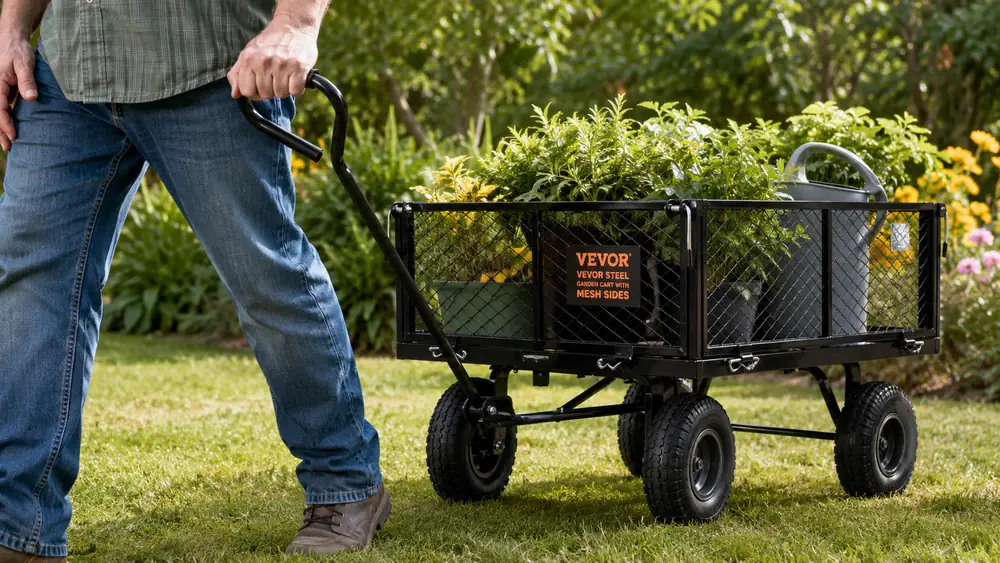
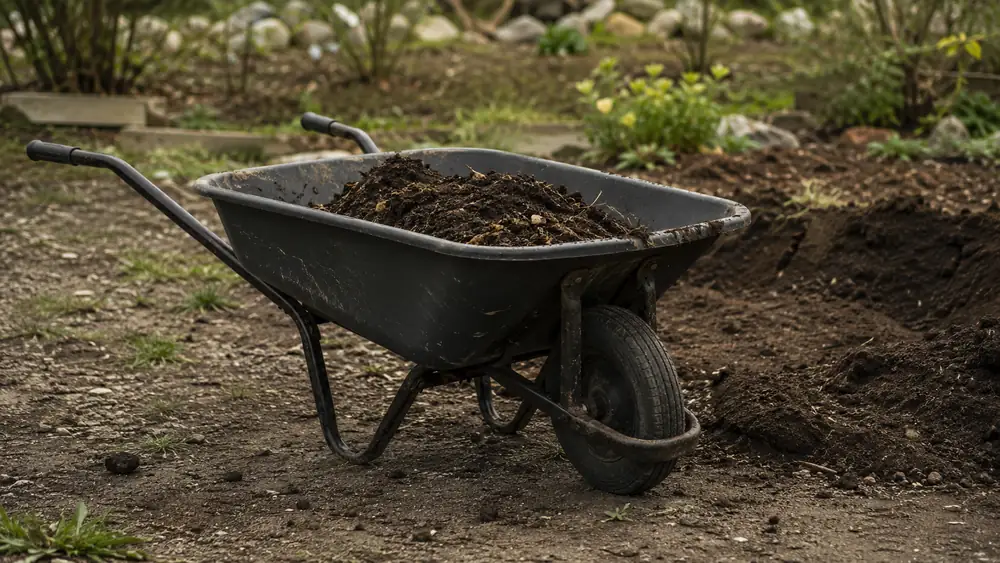
The biggest difference showed up on the very first mulch delivery in April. Ten bags, forty pounds each, dropped at the top of my driveway. With the wheelbarrow I could fit three bags at a time before the single wheel started wobbling under the weight, which meant four trips down the gravel path to the back beds. With the steel cart I loaded six bags at a stretch and made the same trip in two, wheels rolling flat and steady the whole way because there are four of them spreading the weight instead of one trying to balance it all.
The four-wheel design also means the cart sits level when I stop to catch my breath or answer the phone. The wheelbarrow, loaded, has to be set down carefully or it tips and dumps half the load into the grass. That happened to me twice with a full load of bagged soil before I learned to always park it against something solid. I've never had the steel cart tip on its own, loaded or empty, on flat ground or on the slight slope near my shed.
The mesh sides come off entirely, which turned out to matter more than I expected. When my brother-in-law dropped off a load of split firewood in October, I pulled the sides and used the cart as a flatbed, stacking split logs the way I never could in a fixed poly tub. That single feature saved me from stacking firewood by armload, which is exactly the kind of small back-saver that adds up over a long season.
The rotating handle also makes a real difference on the gravel path along my fence line. I can pull the cart behind me at a steady walk instead of pushing and lifting the way a wheelbarrow demands, which matters a lot more at six in the morning before a twelve-hour shift than it did when I first read the spec sheet. My lower back noticed the difference by the second week.
Where the Plastic Wheelbarrow Still Wins
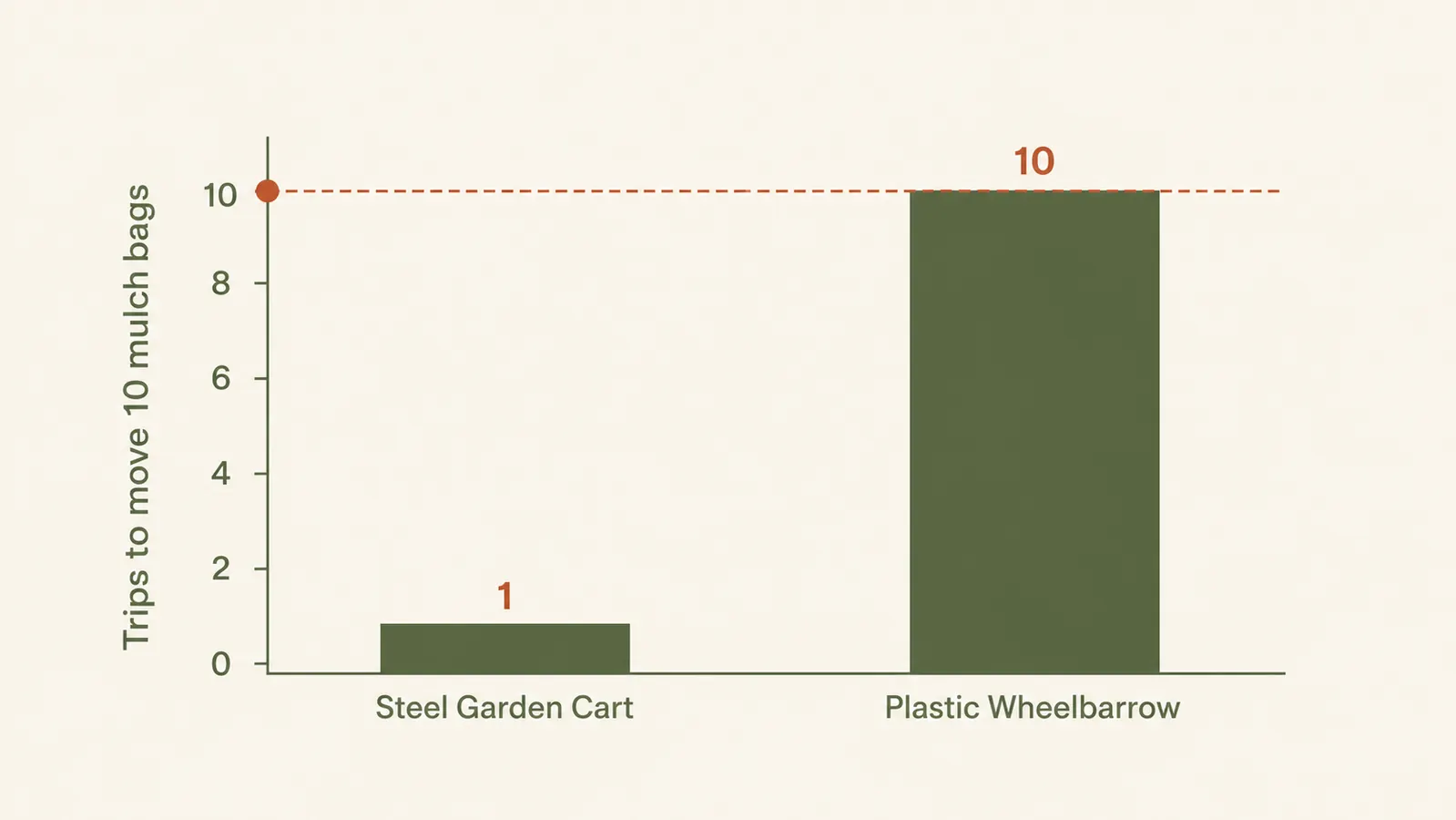
The wheelbarrow isn't obsolete in my shed, and I want to be honest about that. For small, contained jobs, mixing a bag of concrete, hauling wet sand, or moving loose gravel that would sift right through the cart's mesh sides, the solid poly tub does a job the steel cart simply can't. I still grab the wheelbarrow every time I'm patching a section of the garden path or mixing mortar for stepping stones.
It's also lighter to maneuver empty, which matters if you're tight on shed space or need to tuck it into a narrow gap between the fence and the garage. The steel cart is bulkier when it's empty and needs a bit more room to store. And at a lower up front cost depending on size, the wheelbarrow is still the cheaper buy for someone who only needs to haul the occasional small load and isn't dealing with gravel paths or rutted ground.
There's also something to be said for a tool with no assembly. My wheelbarrow came mostly built, tub bolted to the frame, wheel attached, ready to go in about ten minutes. The steel cart took closer to forty five minutes to put together out of the box, tightening bolts on the frame and mounting the wheels myself. That's a one-time cost, but it's worth mentioning if you're buying either one the same week you need it.
Stop losing half your mulch delivery to a wobbling single wheel.
If your yard has any gravel, ruts, or slope to it, the VEVOR Steel Garden Cart carries more per trip and stays upright when you set it down loaded.
Amazon Check Today's Price on Amazon →Maintenance and Storage After a Full Season
By late fall I'd put both haulers through enough seasons of rain, heat, and being left out overnight more than once to see how they aged, not just how they performed fresh out of the box. The steel cart needed almost nothing. I hosed off dried mulch and dirt a couple times over the summer and gave the axles a squirt of lubricant once in July when I noticed a slight squeak pulling it across the gravel. That was the whole maintenance list.
The wheelbarrow needed a bit more attention. The single tire lost air twice over the season, once after rolling over a stray piece of landscape edging, and I had to top it off with a bike pump both times. The poly tub also picked up a network of small surface scratches from grit and gravel that the steel cart's mesh sides never showed, since dirt and debris mostly fall through instead of scraping across a solid surface. Neither issue is a dealbreaker, but it's the kind of small, ongoing upkeep that adds up over years of use, and it's worth knowing about before you buy either one.
The Real Cost Comparison
On the shelf, the wheelbarrow looks like the cheaper tool, and the sticker price backs that up. But cost isn't only the tag. Those two tipped loads of bagged soil meant I lost about a third of a bag scooping spilled dirt back off the grass, plus the time spent doing it on an evening I didn't have much of to spare. Add in the extra trips every single hauling job took with the wheelbarrow, and the time cost alone adds up fast when your gardening windows are already short.
The steel cart's higher price also buys real durability. After a full season on gravel and grass, the frame shows no rust and the mesh sides still clip on cleanly. My old wheelbarrow, by comparison, developed a hairline crack near the wheel mount after its third winter in an unheated shed, plastic doesn't love hard freezes the way welded steel does. That's not a knock on this specific wheelbarrow, it's just the nature of a poly tub versus a steel frame over years of outdoor storage.
Add it all up over a full growing season and the wheelbarrow's lower price tag doesn't hold up quite the way it looks in the store. Fewer trips, no tipped loads, and a frame that should outlast a plastic tub by years make the steel cart the better value for anyone doing regular bulk hauling, even with the higher price at checkout.
Who Should Buy Which
If you're moving mulch, soil, firewood, or anything in bulk across a yard that isn't perfectly flat, the VEVOR Steel Garden Cart is the tool that fits how most home gardeners actually work. It carries more per trip, it doesn't tip when you set it down loaded, and the mesh sides come off for jobs a fixed tub can't handle. That covers the bulk of what I do in my own yard, and I suspect it covers most of what you're hauling too.
If your hauling is mostly small, wet, or loose material, mixing concrete, moving sand, patching a path, on ground that's basically flat, the plastic wheelbarrow still does that job well and costs a bit less to start. I keep mine specifically for those jobs and have no complaints about it in that narrow role.
My honest setup after a full season running both is the steel cart for anything bulky and the wheelbarrow tucked in the corner for the occasional bag of concrete mix. If I had to keep only one, though, it's the steel cart, because it's the one that's actually saved me trips and saved my back every single week since April.
If your driveway drop-off means multiple trips, this cart cuts that number in half.
A full season of mulch, soil, and firewood later, the VEVOR Steel Garden Cart is still the one I reach for first.
Amazon Check Today's Price on Amazon →