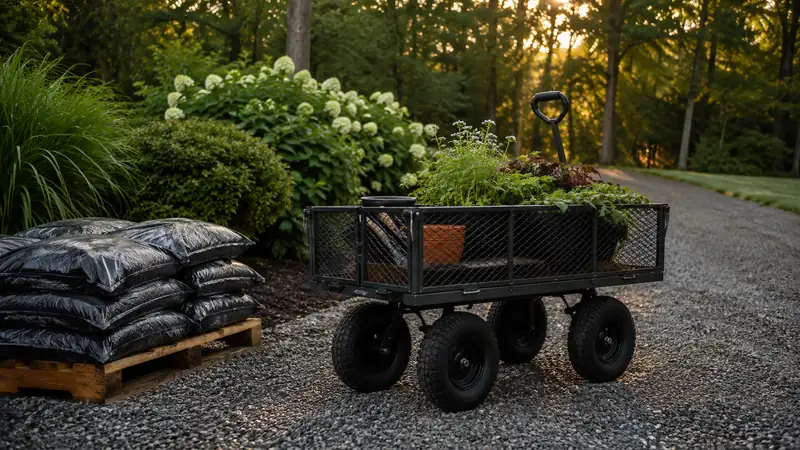
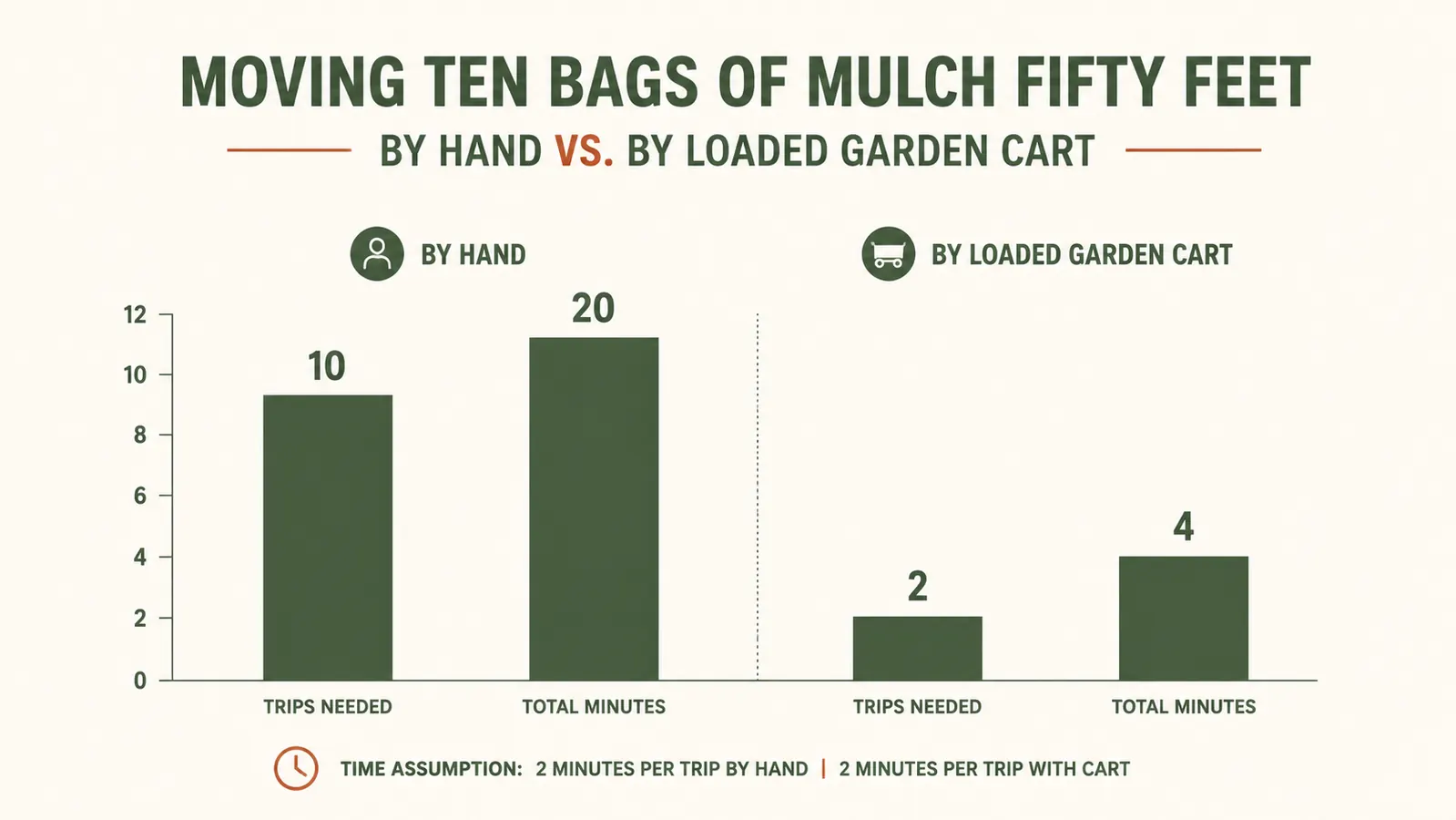
Ten bags of mulch, four bags of garden soil, and a half cord of split firewood by the driveway is not a big job on paper. It is a big job when you are moving all of it by hand, one bag at a time, from the truck to a bed forty feet away, on the one morning you have before an early shift. I used to do exactly that for years, and I would lose most of an hour to trips I did not need to take, plus a sore lower back that lasted into the afternoon and made the rest of my shift miserable.
My mornings start early, out the door before six most days, and whatever hauling I get done happens in the same narrow window as everything else, watering, a quick pass at the beds, coffee I usually forget to drink while it is hot. These days that hauling happens with the VEVOR cart, but for years before that there was no version of that schedule where six separate trips to the truck fit, so for a long stretch I just let deliveries of mulch and soil sit by the driveway for days at a time, which is its own kind of frustrating when you can see the job waiting and cannot get to it.
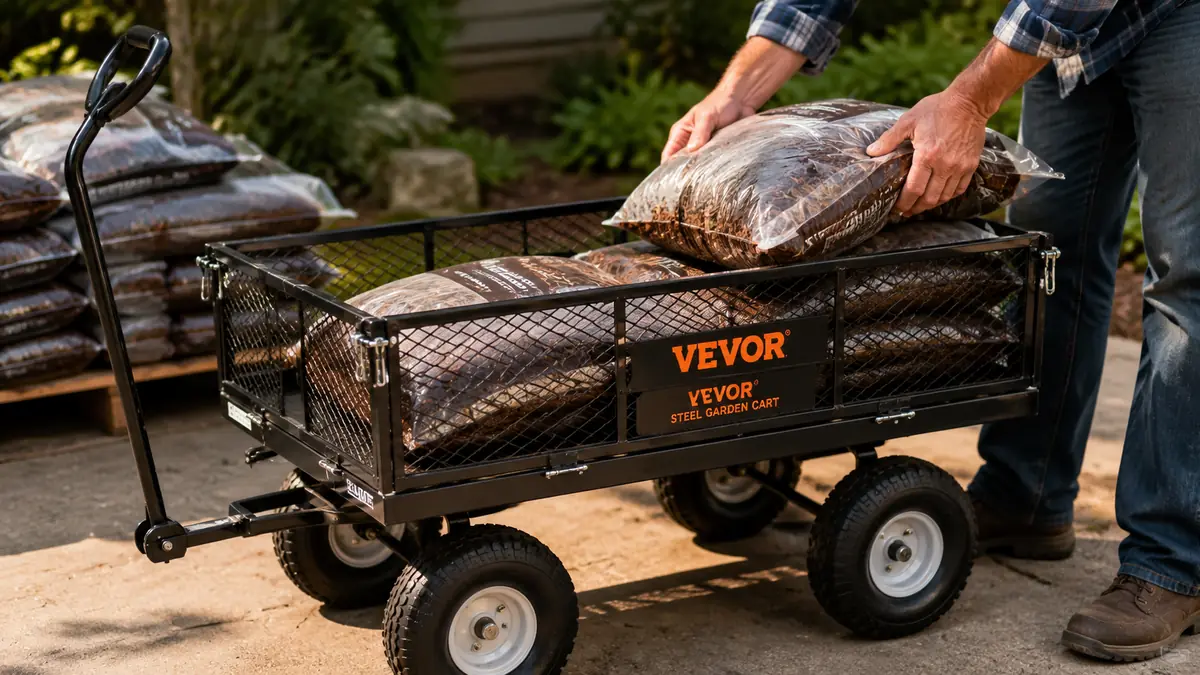
What changed this for me was buying a real steel garden cart instead of trying to make do with an armful at a time or a plastic wheelbarrow that tipped every time I loaded it unevenly. Specifically I use the VEVOR Steel Garden Wagon Cart, rated for 500 pounds, with 10 inch all-terrain tires and mesh sides that come off to convert it to a flatbed. What follows is the exact method I use to move mulch, bagged soil, and firewood in one pass instead of six, using the cart's capacity and its 180 degree rotating handle instead of my own two arms.
Stop Carrying Mulch Bags Two at a Time
The VEVOR Steel Garden Wagon Cart holds up to 500 pounds on 10 inch all-terrain tires, with mesh sides that pull straight off so it becomes a flat bed for firewood or lumber. It is the tool that turned my mulch mornings from six trips into two.
Amazon Check Today's Price on Amazon →Step 1: Know Your Load Before You Fill the Cart
Before I load anything, I do quick math on what I am actually moving. A standard 2 cubic foot bag of mulch runs about 20 to 25 pounds, so ten bags lands somewhere around 220 pounds. Bagged garden soil is heavier per bag, closer to 40 pounds for the same size bag, so four bags of that is another 160 pounds. Add those together and I am at roughly 380 pounds, still well under the cart's 500 pound rating, which means I can move the whole order in one trip instead of splitting it.
Firewood is where I am more careful, since a loosely stacked pile is deceptive and green wood is noticeably heavier than seasoned. I load a rough test batch first, maybe six splits, and get a feel for how the cart handles before committing to a full load. If I am mixing mulch and firewood in the same trip, which I try not to do, I stay well under the rated capacity rather than pushing to the edge of it. The tires and axle are the parts that wear out first when a cart is run at its limit trip after trip, so I would rather make one extra trip a season than shorten the cart's life.
The first weekend I owned this cart, I also spent ten minutes just checking how it was assembled, tightening the axle bolts and the handle pivot with the included hardware, since a cart that arrives slightly loose from shipping will rattle and feel less stable under a heavy load than it actually is. That ten minutes made every load after it feel more solid, and I still give the bolts a quick check at the start of each season before the heavy hauling starts.
Step 2: Load It Back to Front, Heavy Over the Axle
Where the weight sits in the cart matters more than how much weight there is. I load the heaviest bags first, directly over the wheels and axle, then build lighter items toward the front handle end. A cart loaded nose-heavy pulls fine on flat ground but gets hard to control the second you hit a slope or a curb cut, because the weight wants to swing the front down and drag. Loaded correctly, most of the pull is just rolling resistance, not fighting the balance of the load.
For bagged mulch and soil, I stack two bags high at most along the back half, since anything taller starts to shift when the cart hits a rut. For firewood, I lay the first layer flat and perpendicular to the direction of travel, then stack the second layer the opposite way, the same crisscross method you would use stacking a woodpile, so nothing rolls loose when the cart tips slightly going over the yard's low spot by the garden shed.
Step 3: Clear Your Path Before You Pull a Single Load
I walk the empty cart along the route once before I load anything, from the driveway to wherever the mulch or wood is going. This takes maybe ninety seconds and it catches the stuff that turns a five minute haul into fifteen: a hose left across the path, the low spot that fills with water after rain, a gate that needs propping open instead of pushed through one-handed while pulling a loaded cart. The 10 inch all-terrain tires on this cart handle grass and gravel without much trouble, but they still do not like a surprise tree root or a patch of soft mud you did not know was there.
If the route includes a slope of any real grade, I decide before loading whether I am going up it loaded or down it loaded, because those are two very different jobs. Going downhill with 400 pounds behind you means the cart wants to overtake your legs, so I either take a longer flatter route or split that particular load smaller. This sounds like an obvious thing to check, but the first season I owned a cart I did not check it, and I found out the hard way at the top of the slope by the mailbox.
I also check the weather before I plan a big hauling morning, the same way I do for any outside chore. A dry forecast means the gravel path stays firm and the tires roll without sinking. If rain is coming, I try to get the whole delivery moved the evening before instead, since wet soil and mud along the route make even a well-loaded cart noticeably harder to pull, and I would rather deal with that once, planned, than discover it mid-load on a morning I am already short on time.
Step 4: Pull With Your Legs, Not Your Back, and Use the Handle to Reverse
I grip the handle with both hands and start the pull by stepping forward and using my legs, the same way you would start a sled, rather than yanking with my shoulders and lower back. Once the cart is rolling, it takes very little effort to keep it moving on flat ground, which is really the whole point of a wheeled cart over carrying anything by hand. The mistake I made early on was treating the first pull like a normal walking stride. It is not. Give it one deliberate step to get the wheels turning, then settle into your normal pace.
The 180 degree rotating handle on the VEVOR is the feature I use constantly without thinking about it now. Instead of walking the cart in a wide circle to turn it around at the end of a row or in a tight spot by the shed, I rotate the handle to the other end and pull it back out the way I came. In a driveway or a narrow side yard where there is not room to turn a loaded cart around, this alone saves a genuine amount of time and awkward maneuvering over a season of use.
Step 5: Drop the Sides and Dump Instead of Unloading by Hand
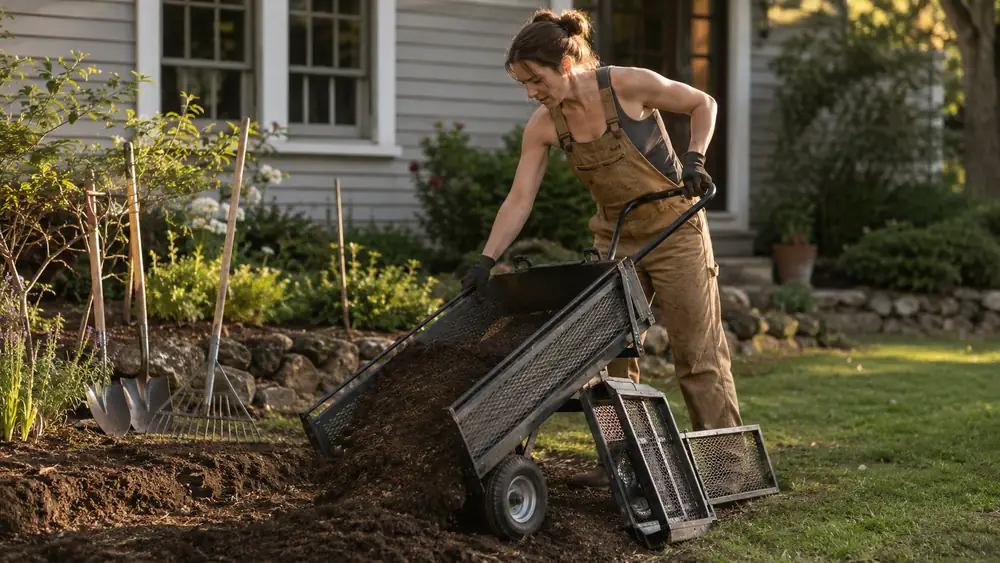
For bagged mulch and soil, I still unload bag by bag, since dumping loose bags is not really faster than lifting them out. But for loose soil, mulch by the scoop, or a load I have shoveled in rather than bagged, the mesh side panels on the VEVOR detach, which turns the whole bed into a flat surface I can tip and slide material off of directly onto the bed I am filling. This is the single biggest time saver in the whole process for anything that is not pre-bagged.
For firewood, I pull the cart alongside the stack location and unload by hand in the crisscross order I loaded it, top layer first, which keeps the remaining stack from shifting mid-unload. Either way, I try to unload facing downhill or on level ground rather than on a slope, since an empty cart with one side detached is lighter and easier for gravity to move on you than you might expect.
Once the cart is empty, I give it a quick once-over before putting it away, brushing loose mulch and soil off the mesh and checking that both side panels clicked back into place if I used the flatbed mode. This takes under a minute and it means the cart is ready for the next load whenever it comes, rather than something I have to fuss with again before I can use it.
What Else Helps
A few habits make this cart earn its keep across a full season rather than just for one big mulch delivery. I keep it parked under the eave of the shed rather than fully exposed, since the steel frame holds up fine in weather but the wheel bearings last longer with a little cover. I also hose off the mesh sides after any load of wet soil or fresh mulch, since dried mud in the mesh weighs more than people expect and makes the next load feel heavier than it is. And I check tire pressure at the start of the season the same way I would on a wheelbarrow, since a slightly soft tire on a 400 pound load is where you start feeling real drag.
I also use the flatbed mode for more than firewood once I realized it converts easily. Bags of potting soil, a stack of paving stones for a small path project, even moving a few small potted shrubs from the truck to the bed line, all of it goes faster on the flatbed than trying to fit odd shapes inside the mesh sides. Buying this cart for mulch season and then using it for every hauling job the rest of the year is honestly where it earns back its price.
The other thing worth mentioning is timing the deliveries themselves around your own schedule rather than the supplier's default. I ask for mulch and soil to be dropped as close to the driveway entrance as the delivery truck can manage, since even ten extra feet of empty-cart walking before the loaded pull adds up across a whole order. A short conversation with the yard or garden center about exactly where they can leave the pallet has saved me more total time over the years than any single change to my hauling method.
The cart did not make the mulch lighter. It made one trip do the work of six.
One Trip Instead of Six, Every Time You Haul
If mulch, soil, and firewood season means an hour of back and forth trips before you even start the actual planting, a 500 pound capacity cart with a flatbed conversion changes the math. Load it once, pull it once, dump it once.
Amazon Check Today's Price on Amazon →